
Getting Johnson County Court Records
Know the case number or a party name? Begin with Kansas CaseSearch. The portal shares permitted case information and, for certain eCourt-era matters, public documents. Johnson County joined Kansas eCourt on November 5, 2024. Because migration and access rules still apply, an online result is never the whole file.
- Search Kansas CaseSearch by full case number or party name.
- Use the free courthouse terminal for public information or documents not shown online.
- Call Records Management at 913-715-3480 for a case-specific price quote.
- Submit one written request form per case in person or by mail.
- Use the KORA path for qualifying records, the reporter path for transcripts, or the audio form for a hearing recording.
For in-person help, Records Management sits at 150 W. Santa Fe Street, Suite 1100, Olathe, Kansas 66061. The counter serves the public weekdays 8 a.m. to noon and 1 to 4:30 p.m. Arrive by 11:45 a.m. or 4:15 p.m. Those cutoffs give staff time to help before closing.
Johnson County Records Request Workflow
The official Records Management instructions call for a separate form per case. Name the case and the specific document. Add contact and delivery details the form asks for. If the docket labels a filing one way, use that label. Do not guess a title. When the wording is unclear, call first. Mail requests go to Clerk of District Court, Attention Records, at the Olathe courthouse. Payment comes before release. By mail, the county takes specified checks, money orders, and cashier's checks. It warns against sending cash. In person you can pay with cash, a check plus identification, or a money order. Debit or credit works with government identification and a processing fee. Email payment is not accepted. A strong request names the Johnson County case number, the parties, and the record title. Say how you want it delivered. Want a transcript or audio? Add the hearing date. Records staff will quote costs, but they will not pick documents for your legal strategy. When a docket entry is vague, describe the date and event. Then ask which filed item sits behind it. That beats asking for an entire file when one journal entry will do.
Court Record Types
A Johnson County court record is more than its docket. In Kansas Rule 106B, the docket goes by another name: the register of actions. It works as a dated index of the case. Underneath it sit the actual documents. These include pleadings, motions, orders, judgments, exhibits, and journal entries. A transcript is different still. A court reporter prepares it as a verbatim account. Audio comes through a separate request process of its own.
- Register of actions
- The chronological event list with brief descriptions.
- Filed document
- The pleading, motion, order, or other item behind an entry.
- Certified copy
- A clerk-authenticated true copy with a raised seal.
- Authentication
- Added verification used before a later Secretary of State apostille step.
Criminal, civil, domestic, probate, juvenile, small-claims, limited-action, and district traffic files all route through the unified Clerk of the District Court office. That division helps track down a file. It is not, however, a separate county clerk.
Four Johnson County Record Products
The right product saves time. A register of actions tells you what happened and when. A filed document gives you the full text, a transcript captures what was said, and audio may preserve a hearing if one exists. Not every hearing gets recorded.
| Product | Best source | Use |
|---|---|---|
| Docket or register | CaseSearch or terminal | Events, settings, status |
| Filed document | Portal, terminal, Records | Full motion, order, judgment |
| Transcript | Court reporter | Verbatim hearing text |
| Audio | KORA/audio request | Available hearing recording |
A docket printout does not arrive certified on its own, so state the exact product you want and whether clerk certification is required.
Inside a Johnson County Court Record
A public case record can hold a lot: identification, court assignment, dated events, filings, settings, and an outcome. What actually displays depends on the case type and access level. Restricted fields may drop out while the open portions stay viewable.
| Case Number | Legacy formats such as YYCR12345 or newer JO-YYYY-CR-123456. |
|---|---|
| Case Type | Criminal, civil, family, probate or mental health, and other court categories. |
| Parties | Public names and roles allowed for display. |
| Events | Filings, motions, settings, orders, and disposition entries. |
| Judge | The assigned judicial officer, subject to reassignment. |
| Documents | Public filed items available at the applicable access level. |
The county says its case files are computer-indexed back to 1980. Searching earlier than that takes a $12 prepayment, and personal checks are not accepted.
Johnson County Archive Timing
Timing at the counter is fairly predictable. Many requests received before 4:15 p.m. are handled on the spot. Anything later usually rolls to the next business day. Archive pulls, microfilm, and large-volume work can run about three days or longer. Mailing time is on you. A portal failure does not mean an older case is missing. Try a party search if a legacy number comes up empty. Then ask Records about index, archive, or microfilm limits. Keep leading zeros in old numbers. Use the JO format for newer statewide identifiers. The 1980 indexing line is practical, not proof that earlier records were destroyed. A pre-1980 search needs that $12 prepayment, with no personal checks accepted. Microfilm may be ready by the next business day. An archived file can take about three business days or more. State any deadline on the form. Leave room for mailing or delivery after the clerk finishes the search.
Fees and Certified Copies
Johnson County sets different prices for print, email, certification, authentication, and search work. Call 913-715-3480 for a real quote before you send any payment.
| Item | Published fee | Note |
|---|---|---|
| Printed copy | Up to $0.50 per page | Ordinary paper copy |
| Emailed copy | $0.60 first document; $0.30 additional | Per case |
| Special emailed copy | $0.90 first; $0.60 additional | Per case |
| Certification | $1 per document | True copy with raised seal |
| Authentication | $2 per document | Additional clerk verification |
| Pre-authorized search | $12 per hour | Payment before release |
An apostille is a separate Kansas Secretary of State step that follows county authentication. Records Management does not supply it.
Johnson County Audio and Transcripts
Need a transcript? Follow the county transcript request instructions. Include the case number and the hearing date. Reach the reporter who was present; if the docket does not say who that was, contact the managing reporter instead. An estimate comes first. Payment is due before transcription begins.
Audio works differently. It uses the KORA/audio form, one form per hearing, and the county asks you to submit it in advance. The listed fee is $50 per hearing up to one day, subject to availability. Keep in mind that not every hearing is recorded. Neither audio nor a transcript replaces the register of actions.
The managing reporter route matters when a Johnson County proceeding was digitally recorded or the docket never identified who covered it. Do not stack several hearing dates onto one form. Each request stays tied to the single proceeding it came from, which keeps the recording matched to the right court record.
Sealed Records and Public Access
Electronic access to court records in Kansas runs under Supreme Court Rules 22 and 106B. The terminal at the courthouse may open a broader public level than the internet does. Neither one exposes nonpublic material. K.S.A. 45-221 lists the exemptions, and juvenile, CINC, expunged, medical, privileged, sealed, and court-restricted records follow more specific rules.
Access rule: A written KORA request receives a response within three business days under K.S.A. 45-218, or an explanation and time estimate when more work is needed.
Denials: a denial should identify the controlling limit, and when practical the custodian may separate open material from exempt content.
Johnson County Custodian Boundaries
The District Court clerk does not hold every public record tied to a case. Police and arrest reports stay with the investigating agency. Deeds, tax, property, vital, and inmate records sit with other county custodians. Municipal court files stay with each city clerk. Federal and bankruptcy matters are separate entirely. Those belong to the United States District Court or Bankruptcy Court for the District of Kansas. Send a police report or a federal request to Johnson County Records. Your search simply stalls. The case number and the originating court usually point to the right custodian. A JO-YYYY-CR-###### file belongs to Johnson County District Court. A city ordinance case belongs to that municipal clerk. That shifts only if an appeal opened a new district file. A federal caption belongs in PACER or at the federal courthouse terminal. Checking ownership first spares both you and Records Management the trouble. It prevents processing a request for a record the office never held. Related records can split across agencies this way. A District Court docket may list a filed exhibit or a law-enforcement witness. The underlying police report stays with the agency. The clerk can hand over the court filing if it is public. The clerk cannot turn an agency report into a Johnson County court record. Request each item from its actual custodian.
Johnson County Records Access Images
The Clerk access source documents the courthouse terminal, index history, and counter logistics.
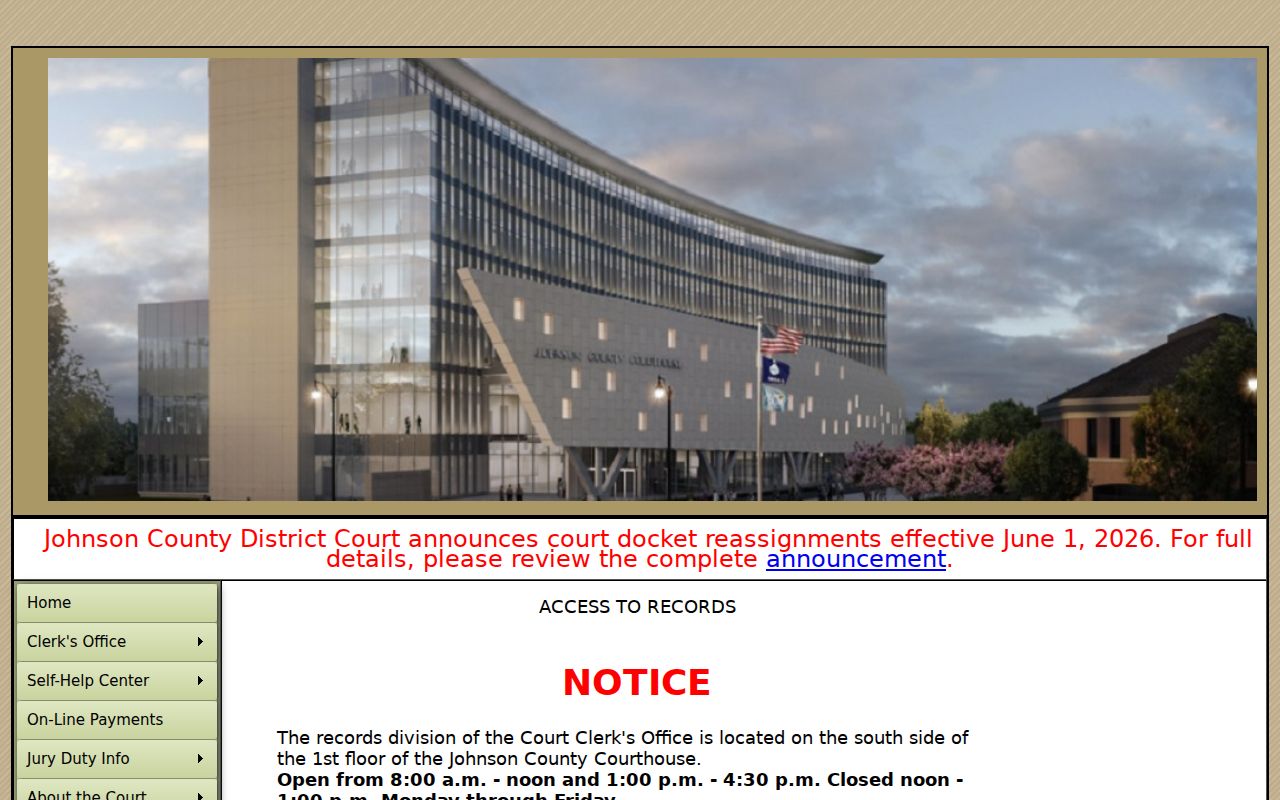
Terminal and counter access still matter to a complete docket search, and the county's own court KORA page shows why. It explains written requests and how audio requests are routed.
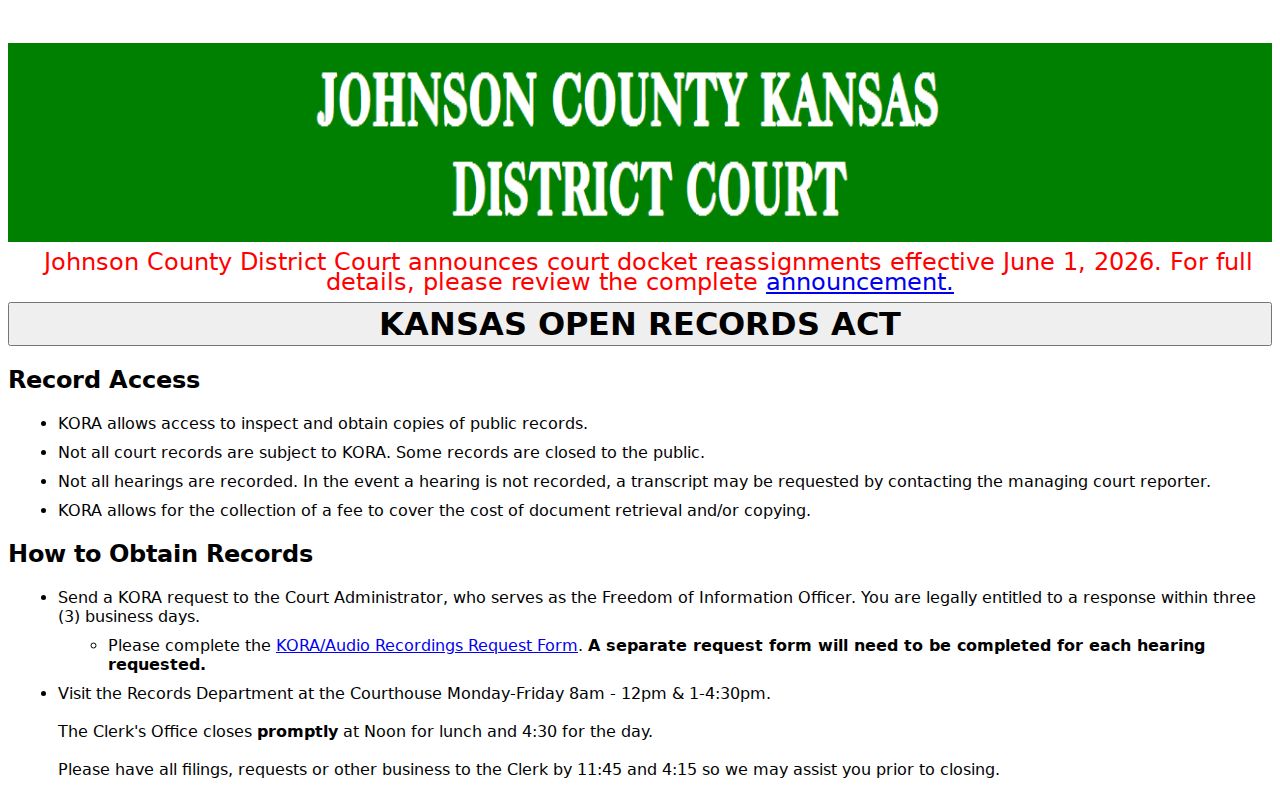
That process covers qualifying records beyond a basic portal result. The official Records Management page gives the copy, payment, and timing instructions.
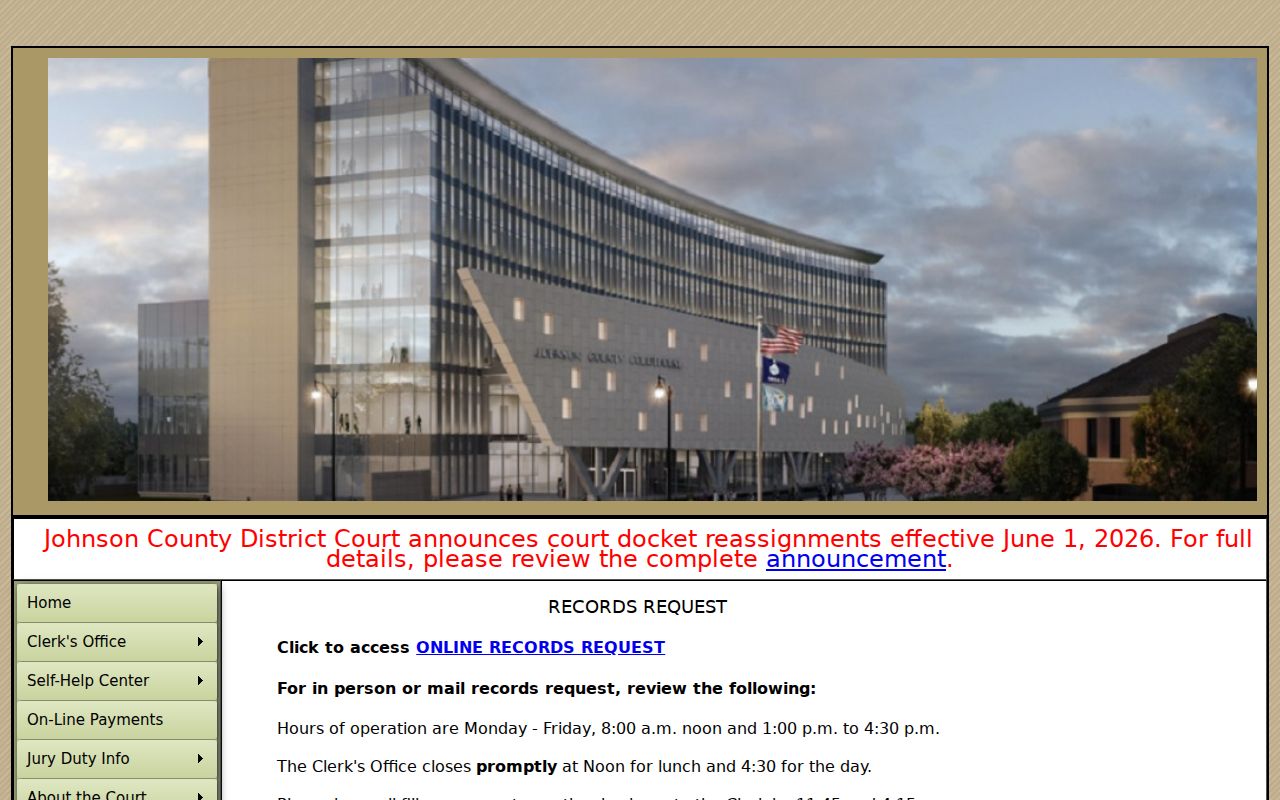
Together, the three sources distinguish finding a case from ordering the actual record.